
– Olivia Garcia
What happened in the last three months?
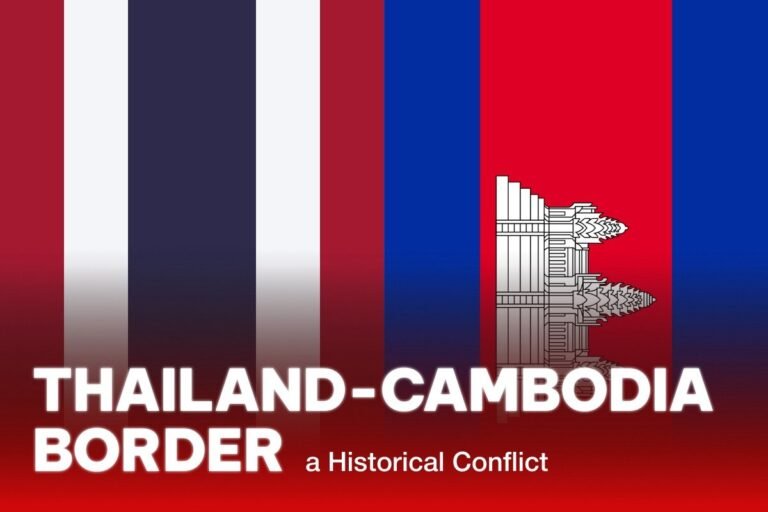
On July 16, a land mine in the border region between the province of Ubon Ratchathani and the province of Preah Vihear injured three Thai patrols. Cambodian authorities denied any involvement.
On July 23, a Thai guard in the same region triggered another land mine. Five soldiers were injured.
On July 24, the Thailand-Cambodia border conflict reawakened with the most intense escalation since 2011. Confrontations happened on the Temple of Ta Muen Thom’s region and, during the following days, other occurrences took place across 12 border locations. In 5 days, approximately 20 people died, 48 were injured and hundreds of thousands had to move.
On July 28, both countries agreed on a ceasefire. Malasya, the current chair of Association of Southeast Asian Nations (ASEAN), hosted the meeting.
Days after the agreement, the Thai Army claimed that one of its soldiers was injured after stepping in a land mine in Thailand’s Surin province. Cambodia again denied any involvement.
In August, Thailand’s government built wire fences in a frontier territory which both governments claim to be theirs: Thailand affirms that it is part of Ban Nong Ya Kaew village in Sa Keo province while Cambodia says it is part of Prey Chan village in Banteay Meanchey province.
On September 17, another violent episode took place precisely in this area. According to the Thai army, some of the approximately 200 Cambodian protesters on the border dismantled the defensive barriers and the Thai police used tear gas and rubber bullets as a response. Civilians threw sticks, stones and used slingshots against them as a response. 23 Cambodian citizens were hurt and some Thai officials were also injured [1][2][3].
Both Thai’s foreign ministry and army claim to have told Cambodia to stop using civilians to invade their national territory. The foreign ministry also said that “All actions by the Thai police were proportionate and appropriate to the circumstances, adhering to human rights principles (…)”. It affirmed that Cambodian protesters actions were a violation of the ceasefire both countries agreed on.
What are the next steps?
Prinya Photisart, Sa Kaeo Governor, met with Um Reatrey, Banteay Meanchey Governor, and demanded that civilians from both nations stay 500 meters away from the disputed area, with no mass mobilization and no heavy weapons in case of military buildup.
If the next General Border Committee meeting does not result in a common agreement, the Thai government affirmed that it will formally demand the de-occupation of Cambodian provinces Ban Nong Jan and Ban Non Ya Kaew within 30 days and take all property.
Cambodia still needs approval from higher authorities regarding the ultimatum.
Other recent events
Death of a Cambodian soldier
On May 28, a Cambodian soldier died in an encounter near the Temple of Preah Vihear. The two sides blamed each other for initiating. This episode initiated months of tension.
Paetongtarn Shinawatrar and Hun Sen phone call leak
Hun Sen, ex-Prime Minister of Cambodia, leaked a June 15 phone call with Paetongtarn Shinawatrar, Thailand’s Prime Minister, in which she referred to her national military as the “opposite side” and called him “uncle”. Shinawatrar was suspended from office. Hun Sen later affirmed that he had not only recorded the conversation but shared it with other 80 Cambodian officials. The episode brought to light the deterioration between both powerful political dynasties.
The leak also worsened the relationship between the elected Thai government and the military. In the opposite way, Hun Sen handed power to his son and, after 40 years in power, he still has the army, the ruling party and the media under his control.
Cambodian structures built in Thai territory
Across three points in the border, Cambodia has established operational bases and homes, as well as implemented agricultural activities. Since finding these constructions, the Chanthaburi and Trat Border Defense Command has sent multiple formal complaints to Cambodian forces.
The Thailand-Cambodia Regional Border Committee had an extraordinary session regarding this topic and, although Thai forces accomplished to push Cambodian personnel from these areas, the constructions have not been removed.
Chemical contamination from border clashes
Indicators of toxic chemicals usage in the border conflict have been identified by Cambodia’s civil society and specialists.
Both soldiers and conflict areas’ villagers have presented symptoms, such as difficulty breathing and signs of potential lung damage. Villagers near the Preah Vihear and the Ta Mone Thom Temples, for example, reported mass deaths of livestock and poultry, besides pigs with skin diseases. Other people have said that using stored rain water has caused vomiting and diarrhoea.
Such evidence raises concerns about chemical contamination and its implications regarding international law and humanitarian principles.
Is there a role to be played by the international community?
Thailand and Cambodia have two different views on how their border dispute should be resolved. Thailand insists on a bilateral resolution without outside intervention, using the 2000 Joint Boundary Commission. But Cambodia wants to internationalize the dispute: on July 25, it referred to the United Nations (UN) Security Council about the recent clashes; and, more than once, it has reached to the ICJ about where the border should lie, specially in relation to the Temple of Preah Vihear. Reaching to the ICJ represents a special dilemma because Thailand does not recognize its jurisdiction and rejects the Court’s involvement.
Both countries are also banned from the use of anti-personnel mines, as are signatory to the Ottawa Convention. However, Thailand has accused Cambodian soldiers of implementing mines along the border, injuring Thai personnel. As Cambodia is known for being one of the most mined countries in the world and it has received overseas funding for it, it is controversial to receive such accusations and it puts the Cambodian government in a delicate position. Thailand is calling the other signatories for action against the neighboring government, which refuses to admit laying mines. Cambodia accused the Thai military of using other weapons that can also threaten civilians, besides publishing photos of damage to the Preah Vihear Temple, a UNESCO World Heritage Site, that they claimed was caused by Thai personnel. Thailand replied by saying they only use these weapons against military targets and has denied damaging the Temple.
After the most recent episode on September 17, Hun Manet, Cambodia Prime Minister, was the one to send letters to world leaders and ASEAN looking for support to stop Thailand’s actions that risk “escalating tensions and widening the conflict”.
The United States and China
The U.S. government urged both countries to de-escalate tensions. It also recommended the implementation of “terms of reference” in order to establish a longer-term observer mission composed by ASEAN member-States on both border territories.
China’s special envoy for Asian Affairs of the Ministry of Foreign Affairs, Deng Xijun, visited Thailand on September 15. Deng expressed China’s support to ASEAN’s involvement in order to solve the conflict and its willingness to assist any of the two sides according to their aspirations.
As two Southeast Asian countries, Thailand and Cambodia currently play a decisive role in the balance of power led by the U.S. and China. Both of the countries involvement in the situation is not by chance and both, as both intend to extend their influence specially on those areas.
Thailand’s proposition for a new referendum
Since 2000, Thailand and Cambodia have relied on an agreement that sets out the joint demarcation of the land boundary. In 2001, another agreement established a framework for cooperation and potential resource sharing. Due to recent events and clashes, they have seemed to have lost credibility especially among the Thai population.
Thailand came up with the proposition for a new referendum to clarify the mandate regarding the agreements. However, Panitan Wattanayagorn, a political scientist at Bangkok’s Chulalongkorn University, affirms that “The government must make clear what will replace them, and this has to be agreed by Cambodia as well”.
Parallelly, Hun Sen’s choice to break his friendship with the Shinawatra’s family makes it seem that he was preparing for a larger conflict.
Historical Context
Until the 15th century, the Khmer Empire dominated a big share of Southeast Asia, including parts of modern Thailand. The Siamese Kingdom of Ayutthanya rose as the Khmer Empire declined, taking western Cambodian territories and adopting Khmer cultural forms. By the end of the 16th century, Cambodia saw itself between Siam and Vietnam and survived by shifting vassalage to both. In the 19th century, the territory became a French protectorate and later part of French Indochina.
France was responsible for much exploitation in Cambodia. However, many historians agree that being under French rule prevented the territory from being absorbed by its neighbours. In 1907, France forced Siam; both signed the Franco-Siamese treaty and it defined much of the current borders between Thailand and Cambodia. During World War II, Thailand reclaimed some territory lost with the treaty, including the Temple of Preah Vihear, that was returned to France (1946) as a condition to join the United Nations.
Cambodia regained independence in 1953, and with that Thai troops reoccupied the Temple. The recently independent country took the dispute to the International Court of Justice (ICJ) in 1959 that, three years later, ruled that the Temple belonged to Cambodia but the surrounding land’s status was left ambiguous. In 2008, the national government registered the Temple of Preah Vihear as a UNESCO World Heritage site; Thailand protested and, between 2008 and 2011, at least 20 people died and thousands were displaced due to border clashes. After Cambodia’s appeal, the ICJ called for all troops to leave the area and confirmed that the Temple and its surroundings were in Cambodian territory.
Due to its independence during the colonial era and its following relative stability, Thailand surpassed Cambodia in economical terms, which went through French colonization, U.S. bombing during the Vietnam War and the Cambodiam genocide under Khmer Rouge. In the last decades, Cambodians have accused Thais of cultural appropriation, that counterpart saying that cultural exchanges happened centuries ago and historical conquests justify claims to certain borders.