
– Gabriela Mazzante
How he got into power:
Nicolás Maduro, 63, has been Venezuela’s president since 2013, leading the governing United Socialist Party of Venezuela (PSUV). Born in Caracas in 1962, He grew up in a family of “moderate means” in Caracas and that his father was active in left-wing politics and the labor movement. Now after over 12 years in power, Maduro maintains an authoritative grip over Venezuela and has built a political persona that leans heavily on his working-class origins. His political rise began in organized labor while working as a bus driver in Caracas. Maduro rose through the transit workers’ union and became a representative for transport workers.This entry point mattered because chavismo, the political movement built around Hugo Chávez, treated unions, mass mobilization, and anti-elite rhetoric as a direct route to legitimacy and power.
Maduro’s ascent is inseparable from Hugo Chávez, the president of Venezuela for 14 years (1999–2013) that established the “Bolivarian Revolution” by using the country’s oil wealth to fund massive social programs and nationalize key industries (chavismo). He campaigned for Chávez’s release after he was imprisoned following the failed 1992 coup attempt, and Maduro continued to position himself as a loyalist inside the emerging chavista coalition. Foi nesse período que conheceu sua futura esposa, Cilia Flores, advogada de Chávez. After the Chavista’s release, Maduro helped found the Fifth Republic Movement (MVR), and joined the winning 1998 campaign that brought Chavez to the presidency.
Once in government, Maduro became part of the institutional redesign that anchored chavismo: he served in the 1999 National Constituent Assembly that rewrote Venezuela’s constitution, then moved into the legislature, eventually becoming president of the National Assembly in 2005-2006.
Maduro´s political career grew significantly when Chávez made him foreign minister in 2006. In that role, he became known for a confrontational posture toward Washington and for cultivating ties meant to blunt U.S. influence (Russia, Iran and China), an approach consistent with the current president´s broader project of Latin American integration and “Bolivarian” anti-imperial politics. Maduro was later elevated to vice president in 2012, and Chávez publicly signaled him as successor as his health deteriorated. Maduro inherited both the chavismo movement and the expectation of continuity.
Winning Power, Then Governing Through Crisis
After Chávez died in March 2013, Maduro won the special presidential election that followed, by a thin margin of 1,6p.p, contested by the competitor Henrique Capriles. The early years of his presidency were soon marked by economic breakdown and social unrest. Venezuela saw the decline of industrial production due to nationalization strategies and lack of industrial investments. Oil exports were also falling and inflation registered the highest level in the world at that time. For the population, this meant shortages of the most basic needs such as medicines, toiletries and milk.
Those conditions fed recurring waves of protest and intensified confrontation between state forces and the opposition. Student protests erupted in early 2014 after the deaths of three people, drawing international attention and underscoring how quickly political conflict was spilling into the streets.
By 2016, the opposition moved from protest to an institutional attempt to remove him: a petition gathered roughly 1.8 million signatures to advance a recall process, while the electoral authority’s delays triggered demonstrations, some of which turned violent. That same year, leaked central bank information suggested Venezuela’s GDP had fallen by nearly 19% and inflation had surged to around 800% – numbers that captured the scale of the country’s economic and institutional freefall.
In 2017, NGOs recorded 9,787 protests against the government. Close to the end of Maduro´s first term, in March, Venezuela’s Supreme Court effectively stripped the opposition-controlled National Assembly of its powers – an action that drew widespread international criticism, and that Maduro ultimately pressured the court to reverse within days. In May, Maduro issued an executive order opening the way for a constituent process designed to overhaul the political order and strengthen executive power—part of a wider strategy of rewriting rules in the middle of conflict. By mid-2017, a dramatic confrontation over legitimacy played out in competing votes and mass mobilization; Britannica records that organizers claimed roughly 7.2 million participated in a plebiscite rejecting the constituent assembly and demanding early elections, while Maduro dismissed the vote as unconstitutional. But the direction remained: executive dominance over institutions, and shrinking room for opposition. The United States responded by freezing Maduro’s assets, escalating a sanctions strategy that increasingly framed his government as authoritarian. (Encyclopedia Britannica).
Another Contested Election: the Guaidó Moment
Maduro secured a second term in 2018 in an election widely criticized by opponents and many outside governments; turnout fell sharply compared with 2013, and regional blocs such as the Lima Group declared the vote illegitimate. (CNN Brasil)
When Maduro began the new term in 2019, the opposition attempted a direct challenge: Juan Guaidó, then head of the opposition-led National Assembly, declared himself interim president in January 2019, arguing Maduro’s 2018 reelection was fraudulent. The United States and a long list of governments and international bodies formally recognized Guaidó. In 2018, The New York Times revealed a U.S. attempt of coup d’état orchestrated with Venezuelan military officials. But the bid stalled because the state (its courts, security apparatus, and key institutions) remained in Maduro’s hands, and the armed forces did not break ranks. (Encyclopedia Britannica)
How He Sustains Power
Maduro’s durability rests on: internal coalition, external backing and authoritative repression. His coalition is built from party control, military loyalty, and the management of insiders who benefit from the system. Institutionally, Maduro expanded the powers of his coalition to include economic capabilities to the military, impunity for economic elites and combined legislative and judicial power to the Assembly – loyal to him. Economically, the wealth becomes concentrated to those complicit with his regime. Maduro managed to maintain internal control of the PSUV, the main socialist party of Latin America, and consolidate support from the armed forces – all of this through multiple economic and social crises. Even organized civilian groups gained paramilitary roles and shared sovereignty in certain regions with nonstate actors such as guerilla forces or narcotrafficants. (ResearchGate, CNN)
Internationally, his survival through the Guaidó crisis also reflected strong supportive signals from governments including China, Russia, Iran, Bolivia and Cuba at key moments when Washington and allies pushed for his removal. (Encyclopedia Britannica, The Guardian)
Meanwhile, Maduro also uses authoritative tools to brutally repress the population with the excessive use of force by state officials and arbitrary arrests of civilians that oppose the regime. Amnesty International found allegations of torture against detainees including women and children and extrajudicial killings. Alongside the deteriorated freedom, Venezuela has recorded high levels of poverty that reach up to 90% of the population. The country´s crisis became one of the world’s largest displacement emergencies. UN platforms have estimated that roughly 7.7 million Venezuelans had left the country by 2023, reflecting this combination of economic collapse and political repression. (Amnesty International, OHCHR)
The New Mandate and the U.S. Escalation
In 2024, Venezuela’s electoral authority declared Nicolas Maduro the winner with about 51.2% of the vote, setting up a new term from January 2025 to January 2031 – while the opposition disputed the result and alleged serious irregularities. The opposition’s leading figure, María Corina Machado, was barred from holding public office, and the opposition later claimed it had access to most tally sheets and that its candidate, Edmundo González Urrutia, was the real winner. (CNN Brasil)
The United States has formally accused Maduro of narcotics-related crimes and, in August 2025, the State Department announced a reward offer of up to $50 million for information leading to his arrest and/or conviction alongside rewards for several other officials. For Maduro, the U.S. allegations and reward are not just legal threats but another chapter in a long-standing narrative of foreign intervention and attempted coups. Throughout his time in power, he has portrayed pressure from Washington and the U.S. far right as part of a broader campaign against his government and left-wing movements across Latin America. That framing has allowed him to rally loyalists and justify repression at home, even as his rule remains defined by contested elections and the suppression of the opposition. The renewed U.S. escalation now sets the stage for another test of whether external pressure can weaken or ultimately reinforce his grip on power. ((U.S. Department of the State, BBC)
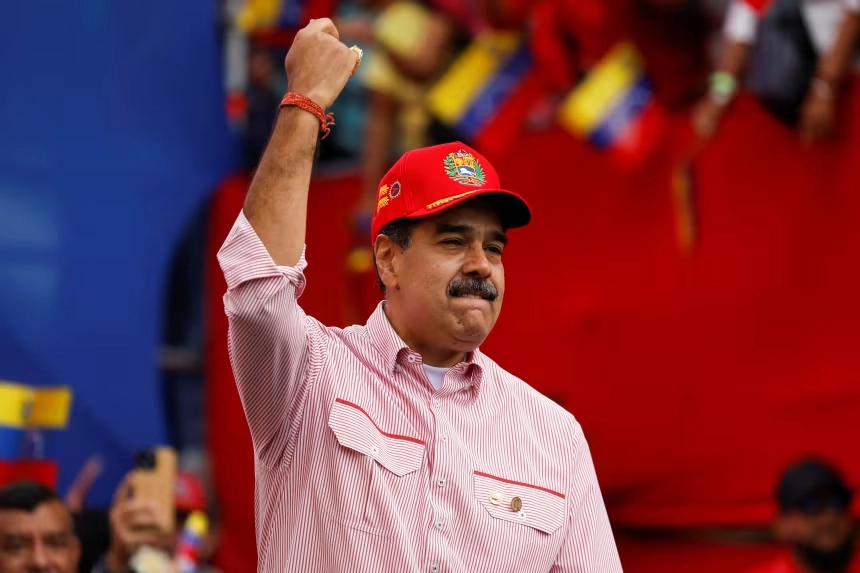
Source: Leonardo Fernandez Viloria/Reuters