
– Desmond Verbani
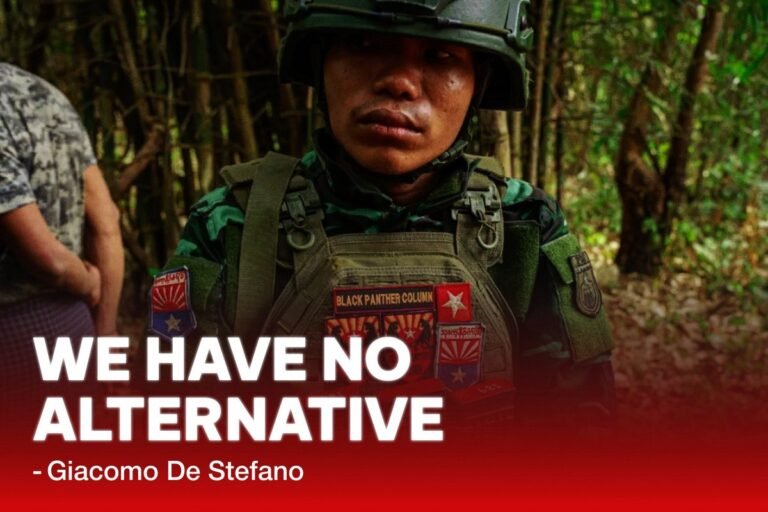
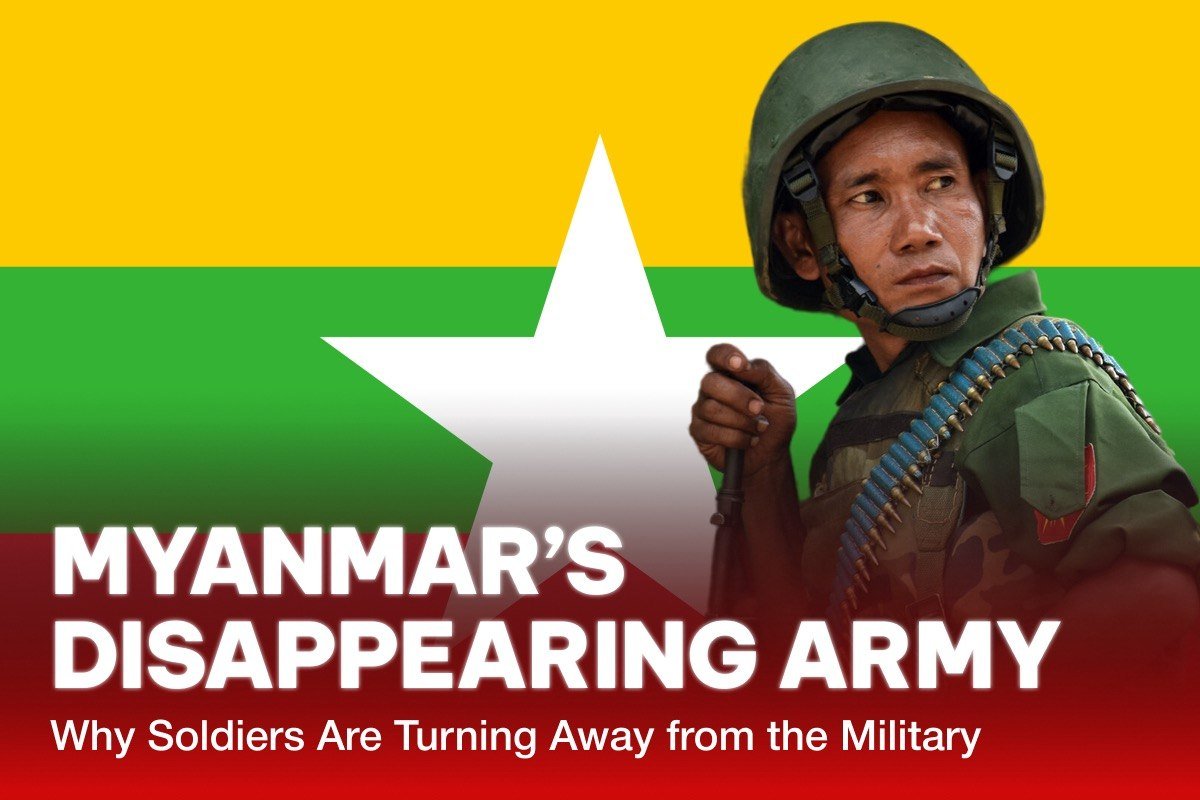
No longer able to bear the conditions of war and the weight of guilt over their actions against their own people, Myanmar’s government soldiers are abandoning their institution – not out of fear, but because they no longer believe in the cause they were ordered to kill for.
Nowhere are the contradictions of a modern army more visible than in Myanmar, where decades of ethnic warfare, propaganda, and economic decay have collided to make defection both a moral choice, and an act of survival.
Myanmar’s war has raged almost continuously since the 1950’s – long before the 2021 coup – against Ethnic Armed Organisations across the country. That long history provides the backdrop for understanding what actually drives soldiers to abandon one of the world’s most entrenched military institutions.
The Roots of a Collapsing Institutions
The Tatmadaw has ruled Myanmar since General Ne Win’s coup in 1962. Today’s defections are unfolding amidst the chaos of a nationwide civil war that began after the February 2021 coup, when the military overthrew the elected party, National League for Democracy.
In the four years since, the Junta’s brutality, mounting losses, and collapsing morale have pushed thousands of soldiers and police to defect or desert. The army’s campaign of terror – burning civilians alive, torching villages, and using rape as a weapon – has poisoned its own ranks.
Defectors describe not only the crimes they were ordered to commit, but the gradual erosion of belief that followed. Abandoning the army, many say, was the only act of conscience left to them.
How Many Soldiers Remain?
Accurate troop numbers are nearly impossible to verify. A 2023 report by the U.S. Institute of Peace estimated the Tatmadaw’s pre-coup manpower at no more than 150,000 soldiers – with 70,000 of them being combat roles.
Myanmar’s Military Is Smaller Than Commonly Thought — and Shrinking Fast
As of 2025, the CIA World Factbook still lists around 150,000 personnel, though this likely includes a mix of active and non-combatant forces and already accounts for “personnel losses.”
A defector from the Tatmadaw’s Military Intelligence (Sa Ya Pha) told Conflict Wire that, in his estimation, current manpower is closer to 120,000 – a figure complicated by constant casualties, defections, and aggressive conscription drives.
Despite its reduced numbers, the Tatmadaw remains formidable. But morale is crumbling, especially among low-ranking soldiers – the men most likely to defect. They are caught between a despised command structure and a fragmented resistance landscape offering no single, unified force to join.
The Faces Behind the Defections
In Karen State, Wunna Kyaw and several of his comrades defected in early 2024, according to a Guardian report titled “Why Should I Kill Our Own?”
He escaped his base under cover of darkness, convinced he would die if he stayed. “I believed I would die if I did not defect, he said. “I feel sorry for the people – people the age of my parents are being killed, and their houses destroyed for no reason. I saw it, I witnessed that.”
Such moral revulsion is common. Years of atrocities have made defection both an act of conscience and a survival strategy. Each burned village adds weight to the soldiers’ doubts, until escape becomes inevitable. The Tatmadaw’s own violence breeds the very defections it fears.
Another soldier, Staff Sergeant Ko Aung Yin, left after two decades in uniform, as Frontier Myanmar reported in late 2024.
Embracing the enemy: Resistance forces welcome new defectors
He described rampant methamphetamine use inside the army:
“The soldiers in my squad were becoming disoriented, and they didn’t want to work anymore. When I discovered it was because of drugs and where they got them from, I was very upset.” He also mentioned the drugs were being supplied by the very officers commanding their unit.
Through sources in, but not exclusively, Chin State and Tanintharyi Region, Conflict Wire corroborated widespread stimulant use within frontline units. The drugs keep soldiers alert and obedient, but also unhinged – a wartime symptom of commanders who act more like warlords than officers. When your soldiers no longer want to run at the enemy, the quick fix is chemical.
The Hidden Rot
Defections are driven by more than guilt or exhaustion. Many soldiers describe physical abuse from officers, unpaid wages, and institutional culture of corruption.
On paper, a typical Tatmadaw regiment should field around 800 men. In practice, many operate at half strength or less. Commanders routinely fail to report deaths, pocketing the salaries of the dead. Others falsify casualty figures to appear competent to their superiors.
This deception climbs the chain of command. Even senior generals may no longer know how many soldiers are left in the field – or how many have already switched sides.
The Ones Who Can’t Leave
For every soldier who escapes, many more stay trapped. Fear of retaliation against families, or execution if caught, keeps thousands in uniform.
A former Military Intelligence officer told Conflict Wire that numerous garrisons and outposts quietly wish to surrender.
“They told me if the rebels attack, they won’t resist,” he said.
There is existing terminology for these particular kinds of soldier, especially for those who are actively feeding intelligence to revolutionary forces from inside the Tatmadaw. Referred to as “Watermelons” green (army) on the outside, but red (rebel) on the inside. However the military government is aware of these activities, and is pursuing a “Fake Watermelon” strategy, of feeding false information to the rebel groups under the guise of being a real “Watermelon”.
This not only makes it much harder for rebel groups to distinguish real intel between fake intel, but also creates a further difficulty for those who wish to defect; any intelligence offered as payment for repatriation into the anti-dictatorship cause, is met with scrutiny and suspicion.
A Military Consuming Itself
The Tatmadaw remain dangerous, well-armed, and adaptive. But its cohesion is rotting from within. Commanders lie about casualties, soldiers self-medicate, and loyalty is maintained by fear rather than conviction.
Defections alone will not collapse Myanmar’s military overnight – but they represent a slow internal erosion that no amount of firepower can reverse. In the end, this war may not be decided by the resistance’s strength, but by how long the army can keep believing in itself.