
– Giacomo De Stefano – August 2025
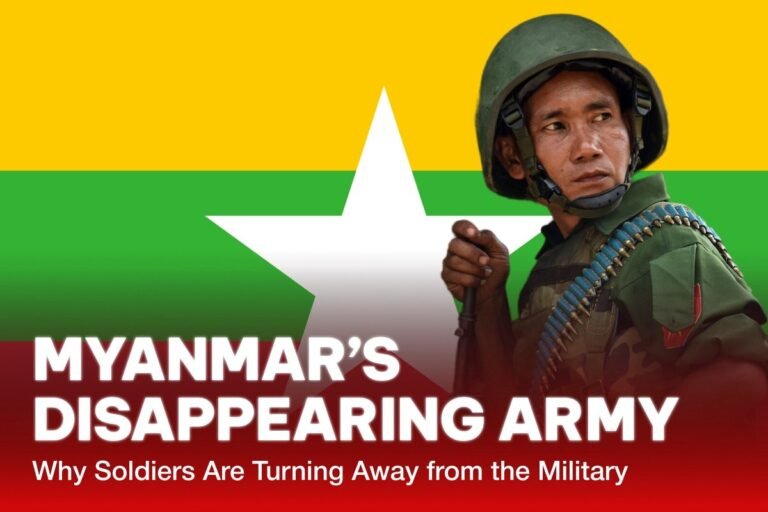
The war being fought in Myanmar is one of the most important – and most ignored – conflicts of these years. The conflict erupted in February 2021 when, after a few years of democratic openings, the military regained control of the country, imprisoning elected leaders and violently suppressing all dissent. In response to this crisis, opposition groups and historically rival ethnic militias have joined the fight against the military junta. I went to Myanmar in early 2025, where I spent a week with guerrillas and activists engaged against the regime.
In January 2025, I crossed the border illegally from Thailand into Myanmar by traversing the Moei River. After contacting anti-regime fighters and activists through social media – natural communication channels, since most of them are very young and highly active online – I got in touch with Philip, a friendly guy who works in the media department of the Karenni National Defence Force (KNDF), the armed wing of the Karenni State. That connection didn’t pan out, but I reached Betty, who advised me to link up with the Karen National Liberation Army (KNLA). A week later I was in Bangkok, Thailand. As soon as I landed I set off for Chiang Mai in the north of the country to meet her. We had dinner, and the next day we took a bus to Mae Sot, a border town long home to Burmese exiles.
Mae Sot is an ambiguous place, marked by smuggling and continuous tensions, yet on the surface it can appear unusually calm. The city overlooks the Moei River, which marks the border with Myanmar. At dawn the next day, still groggy from jetlag – because only the morning before I had been in Bovisa, Milan – I was in a pickup with Betty and Saw Moe, a commander of the Karen National Union (KNU), heading out of town along the riverbank. There was a small wooden shack where an old man sat watching the river and smoking a homemade cigarette. His job was to check that Thai police were not nearby. Part of the “official expenses” of the trip – the “what the fee covers” – was this little bribe. Moments later, a man with a small boat appeared out of nowhere. They made me cover my face with a kefiah and we crossed the Moei. On the other side, inside Burmese territory, Saw Saey was waiting, armed with an M-16 in a Toyota Hilux. He would be my driver, my escort, my shadow: a bright, quiet guy, always alert. I was in Myanmar.
I spent a week with the soldiers of Brigade Six of the KNLA, the armed wing of the Union National Karen (KNU), which for decades has fought for autonomy for its people – the third largest ethnolinguistic group in Myanmar. Territory under KNLA control in southeastern Myanmar is divided among seven brigades, each responsible for a specific zone. These units are the beating heart of the Karen army: they operate autonomously but are united in the common struggle against the military junta. In particular, Brigade Six played a key role in the creation of the National Unity Government (NUG), the shadow government formed after the February 2021 coup that brings together democratic and autonomist movements fighting the regime. The Karen paramilitaries were among the first to offer logistical support and training to the NUG’s armed wing, the People’s Defence Forces (PDF), thus enabling a real armed response to the junta.
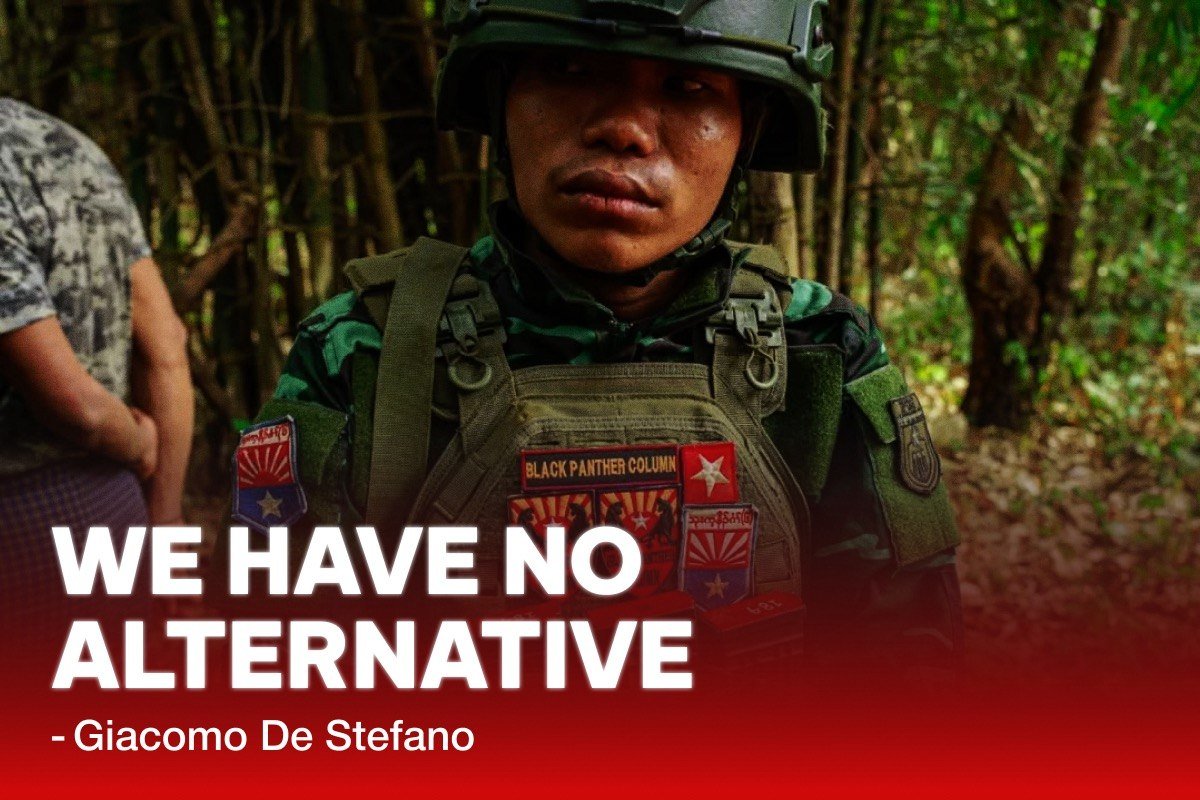
My stay was concentrated on the front line at Kawkareik, a strategically important city on the Asian Highway 1, a road network connecting the continent from Japan to Turkey through Myanmar. There, I lived closely with two mobile units: the Cobra Column and the Black Panther Column, both known for audacious frontline operations. The Cobra Column specializes in rapid guerrilla incursions into junta-controlled territory, with drone support that has even led to territorial gains. The Black Panther Column has a more defensive role, especially protecting Karen villages from enemy offensives.
The rebel base camp was well hidden among trees and further disguised with green tarps, fishing nets, and dry leaves; it isn’t visible until you’re inside. There are no fixed structures – only lightweight bamboo huts, poles and at most some sandbags. War here is made of constant movement; staying still too long is far too risky, not least because the approaching monsoon season forces continuous relocation and adaptation. The result is sleeping in hammocks strung between poles or on raised platforms and cooking in huts with no walls – only in more stable rear areas are roofs made with dry jungle leaves built. Supplies – hung from the ceiling to protect them from insects and animals – are few and more or less always the same: boiled rice, greens, and if lucky, fish from streams or frogs. Now and then, some samosas or fresh meat arrive from the rear; otherwise, fighters hunt birds to fry. Every day for the guerrillas is long and tense, punctuated by guard duty, weapon maintenance – taken apart, cleaned, and reassembled on plastic sheets – and patrols along jungle trails.
Daily life is governed by a few repetitive actions. They eat sitting on the ground, in silence broken only by occasional jokes or laughter. To wash, they fill a bucket from rainwater cisterns and pour it over themselves, in the same spot where they wash dishes and clothes. It’s a Spartan system with no comforts, though there are exceptions. While most fighters wear plastic sandals, some boast shiny military boots usually obtained from clandestine markets on the Thai border or from the bodies of enemy soldiers. A few even have mosquito nets, but most live exposed to insects, protected only by smoke from fires. It’s no accident many militiamen have malaria; almost all chew Areca nuts all day to guard against it – a fruit whose consumption, despite harmful effects, is extremely widespread in the region and consumed alternately with cigarettes.
Weapons are never left alone; people even sleep with them. Chinese Kalashnikovs, old M-16s, homemade rifles built in clandestine workshops hidden among the Karen mountains. Yet despite war and poverty, there’s room for lightness. When possible, they laugh, joke, drink local whisky, and even after funerals or hard-won battles, they sometimes bathe together in the river, using floats as if the war had ended. Some of this spirit perhaps comes from Buddhist culture and an acceptance of suffering as a necessary component of life.
I also encountered preparation of homemade weapons. In conditions of deprivation and limited economic and military resources, resistance forces rely on inventiveness to build arms and ammunition: explosives, for example, are made with improvised materials like fire extinguishers or spray cans. As people I met said, “we have no choice.” Every day the resistance adapts, looking for new modes of combat against a regime that can count on surprising military power. The Tatmadaw – Myanmar’s armed forces – historically has been at the center of the country’s political life, ruling it for almost thirty years after the 1962 coup. Even after a brief democratic window, the military retained strong control over institutions, reserving 25 % of parliamentary seats and key ministries.
Among Burmese guerrillas I spoke with was a female PDF soldier who gave only her nom de guerre Mango. Up until a few years ago Mango worked as a shop assistant and after the COVID pandemic ran an online store. After the coup she began peacefully protesting the junta, but when these were violently suppressed and police tried to arrest her, she fled and joined groups fighting in the jungle. Her aim is simple: to see democracy return to Myanmar and, once the revolution is over, to resume her dream of becoming a fashion designer. Another fighter, Androus, shared that he came from a transport management background and chose armed struggle in March 2021 after becoming disillusioned with the effectiveness of nonviolent protest against such a brutal regime. He is serious about the gravity of the situation but hopeful that cooperation between ethnic militias and opposition factions will yield positive outcomes.
I also met a foreign fighter from the West. On his third trip to Myanmar, he alternated front-line deployments with periods back home to work and support his unit – providing gas masks, thermal sights, and other equipment. I promised to protect his identity. He told me he had previously fought with the FARC in Colombia and with Autodefensas in Mexico, and that other foreign volunteers – an Argentine still at the front and two Anglo-Saxons killed near Kawkareik – were present. In his view this experience has been somewhat calmer than others; on one previous trip he was sent straight into battle upon arrival to try to take Kawkareik. That battle ended in a severe defeat for the rebels due both to strategic mistakes and the junta’s heavy use of aerial bombardment.
Most fighters are heavily tattooed with messages and symbols tied to resistance. Common faces include Che Guevara, Buddha, Gandhi, and Aung San – the father of Burmese independence assassinated in 1947 and revered across the country. He was also Aung San Suu Kyi’s father; “the Lady” became a long-time symbol of nonviolent struggle against military rule, and though now imprisoned and controversial internationally due to her silence on the Rohingya crisis, she remains a moral figure for many.
Tattoos also include more pop-culture references like the Hunger Games logo – an emblem of the Spring Revolution that saw massive popular uprisings against the junta in 2021. There are numerous nods to Burmese protest musicians like Rebel Riot and Nitric Acid (a rap group founded by activist Phyo Zeya Thaw, who died in prison), reflecting a blending of political and cultural references that help universalize the Burmese revolt.
After leaving Myanmar, I spent a week in Chiang Mai reviewing material with a group of Burmese exiles involved in the revolution: nights of laughter, beer, cannabis, and conversation. Despite seeming from distant worlds, we understood each other perfectly – sharing the same books, references, critical worldview. They had experience in antifascist movements, knew the Palestinian issue and the YPG, quoted Orwell, and sang The Internationale. Among them were resistance soldiers who, when away from the front, found refuge, affection, and protection in these safe spaces. Some evenings were in a bar-hostel called The Commune, always connected to resistance and run by Burmese.
I met Rebel Riot members too – a punk band formed in Yangon in 2007 during the “Saffron Revolution,” a monk-led peaceful uprising against military rule. Their music is a direct response to repression, corruption, and social injustice in Myanmar. From the start, they used punk as a tool of resistance and human rights advocacy. Their activism went beyond music to community support like Food Not Bombs (feeding the homeless) and after the 2021 coup they openly supported protest movements. Their songs are among the most listened to by fighters, including a punk version of Bella Ciao recorded clandestinely on Yangon’s streets during 2021 protests. Music became a powerful symbolic weapon, linked to universal language that unites people in antifascism and the struggle for freedom.
I also met activists and journalists in Chiang Mai frequenting resistance circles: Ye, a photographer whose image became the ebook cover of Narcotopia (Patrick Winn’s bestseller on the Wa people’s semi-independence in northern Myanmar), and Zin Ko Ko, a young activist with Myanmar Witness, documenting human-rights violations with OSINT techniques to dismantle regime propaganda and build an archive of evidence for international justice.
While the generations of our grandparents and those of Betty, Mango, Androus, and Ye might seem from parallel universes, the new Burmese generations resemble us more than we think: reading Orwell, dreaming of studying fashion at Marangoni, playing punk, and tattooing Che Guevara. Entering Myanmar, I thought I was arriving in a remote world with 135 ethnic groups, eight varieties of mango, and right-hand-drive cars; but at the heart of the Spring Revolution, I met young people whose aspirations speak a global language – the same contradictions and hopes we all share.