
– Olivia Garcia
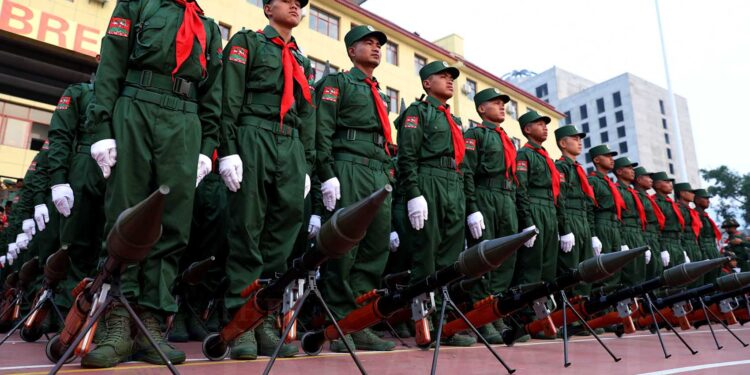
Photo: UWSA troops in the Wa capital Panghsang, 2019 – The Irrawaddy
What is the United Wa State Army?
The autonomous Wa state in northeast Myanmar is ruled by the United Wa State Party (UWSP); the United Wa State Army (UWSA) is its armed wing. With around 45.000 soldiers, the UWSA controls two separate territories: one in the border with China — the Wa state — and one in the southeastern border with Thailand — in the Shan state.
The UWSA can be considered the most powerful ethnic group in Myanmar, and this is due to three main aspects: its autonomous character; its relationship with China; and its business led mindset. We will explain these three factors in the following sections.
Origin and formation
The Wa people are located in the Wa state, in northeast Myanmar, but also in the Chinese Yunnan province, due to their historically mountainous border character.
In the 1950s, Chiang Kai-Shek’s government collapsed in China and multiple Kuomintang (KMT) members went to Myanmar’s northeastern region. During the 1960s, the People Liberation Army (PLA) started building their presence in the region, leading to the establishment of the Communist Party of Burma (CPB). The Wa people became the main recruits for the CPB, which were able to capture the Wa hills and overcome other armed groups.
In 1989, the soldiers revolted and the party was divided into different factions, all of which signed cease-fire agreements with Rangoon. The Wa faction was the United Wa State Army. The national military, with no desire to fight a heavily armed militia, gave full autonomy for the USWA to govern the Wa Self-Administered Division or, as the UWSP call, the Wa state.
While consolidating the power of the new army, the UWSA fought other powers in the Golden Triangle region, especially the Mengtai Army of Khun Sa.
This helped to build almost a decade of good relationship with the central government, which also benefited from business deals involving mining or drugs. In 1996, after defeating the Mengtai, the UWSA took more than a hundred thousand people from the Wa state’s original territorial domain to the area in the Golden Triangle now named the Southern Command.
Political organization
Although Myanmar’s central government and its constitution don’t recognize the Wa state as independent, they possess a very independent administrative body with no presence of national authority. Both territorial domains are governed by the UWSP Central Committee and the Central Working Committee, the only party ruling the state. Their autonomous character is also preserved by the ceasefire and peace agreements with the regime signed, from 1989 to 2011, by UWSP. The party’s main political goal is precisely the formal recognition of its State and the legitimization of both territories it controls.
The Wa state administrative structures and local governance is one of the reasons it can be considered the most powerful ethnic armed organization in Myanmar. Its system is deeply influenced by the Chinese: schools and prisons, for example, were not only based on China’s governance models but also supported by its government. The Wa blend Chinese-style bureaucratic institutions with clan-based patronage networks. Indirectly, the UWSP was also influenced by China: it adopted a formal governing structure because the Chinese government expected bureaucratic administration and State-like institutions from its borderland partners.
What differentiates the UWSP from other non-state armed groups and from the Chinese government system is, besides the lack of Myanmar’s central government presence, the strength of their military principles as guidance for their institutions.
The most relevant political figure in the Wa state is Bao YouXiang. He is not only the current chairperson of the government, but also UWSP’s general secretary and UWSA’s commander-in-chief. In the late 1960s, when the Beijing-backed CPB emerged, it formed alliances with local guerilla bands, including one led by YouXiang. In 1989, when the party collapsed, he dominated one of the factions: the United Wa State Army. From that moment onwards, he has been the main authority in the Wa state government.
Military organization
The Northern Wa Region is where the headquarters is based and it is composed by:
- Brigade 318,
- Brigade 418,
- Brigade 468,
- and Brigade 618.
The Southern Wa Region is composed by:
- Brigade 248,
- Brigade 518,
- Brigade 771,
- Brigade 775,
- and Brigade 778.
Coercive recruitment systems, such as forced conscription, “replacement conscription” of relatives and punitive detentions of family members in case of fleeing from recruitments, were and still are widespread and institutionalized.
With around 45.000 soldiers, the UWSA operates with heavily armed soldiers. Back in time, the CPB received a lot of Chinese support in terms of military equipment; and this extensive help has allowed China to maintain influence in the region through the successors UWSP and UWSA. Many leaders of the CPB were former Red Guards from Yunnan and stayed even after the collapse of the party.
Nowadays, the PLA is a supplier of weaponry, FN-6 MANPADS, armored vehicles, artillery.
In the end, a well-armed UWSA that keeps peace with Myanmar’s central government is in accordance with China’s interests: it gives the Chinese leverage related to the China-Myanmar Economic Corridor (CMEC); oil and gas pipelines; and the Kyaukpyu deep-sea port, which gives China direct access to the Indian Sea.
Economic organization
The UWSA possesses the largest narcotics network in the whole region, involving the production of heroin and later methamphetamine. After the agreements in 1989, the system operated with little interference from the central government. In 2005, the United States indicted multiple Wa leaders as related to narcotics trafficking, including the Wei brothers who had run heroin refineries for years in the Myanmar-Thailand Golden Triangle region conquered after the defeat of the Mengtai Army.
The drug trafficking evolved into illicit-to-licit capital conversion via the Hong Pang Group, not Thawda Win Co., in infrastructure, mining and gems. However, it is hard to measure to what extent the USWA’s economy has left the narcotic field behind.
Nevertheless, it is proved that the UWSA created a dual economy: it has simultaneously invested in airlines, hotels, real estate and cross-border trade, developing legitimate business ties with mainly Chinese and Burmese conglomerates. In the 1990s, the Wa also developed large-scale rubber plantations with the help of Chinese investors.
China pressures the UWSA to not let narcotics inflow into Yunnan. Chinese companies are deeply interested in mining and rubber projects in Wa supporting an alternative development and facilitating extraction in the region.
Wa areas have also historically been rich in silver, gold, iron and tin. This shaped and still shapes outside powers’ interest; therefore, the Wa people have used mining concessions as a political tool to maintain autonomy. Especially Chinese miner-entrepreneurs have long benefited from the extraction in Wa areas. Nowadays, there are high-security mines in the region, holding lead, gold, silver and platinum, and being operated by China, Thailand and Laos investors subject to shared profits among UWSA and Myanmar state authorities.
In 2013, tin deposits were discovered in the Wa region and became one of the world’s largest tin sources. It supplies one-tenth of global tin to China.
In 2021, rare earth mining zones opened on UWSA territory and Chinese companies are informally involved or through shadow partners. Here we are presented with another duality: while China claims to support alternative development so the Wa state can transition to legal trade forms, the country is benefiting from informal cross-border flows.
Together with that, China stopped the exploration of rare earth elements (REE) due to its impact on nature, so it heavily relies on the degradation of the Wa natural environment and its resources, which is shown by massive deforestation, populations’ displacement or people conscripted into labor.
During a period from 2023 to 2024, these mines were largely closed due to new investment rules for those involved in the trade. It is hard to conclude what was the real reason. What is indeed real is that the lack of these minerals, especially tin, affects the whole world. When one of the world’s biggest providers of such elements stops trading, the market of electronic devices, for example, is deeply affected. Consequently, the effects can go way beyond the Wa state and reach all over the globe.
The taxes around mining, transport and processing of these rare elements go mainly to the military budget.
Regional tensions
In November 2024, Thailand asked for the removal of bases and troops located on the border region between Thai and Wa territory. The UWSA replied “that the issue has to be solved between governments” and refused to dismantle the bases.
National alliances
The UWSP is the chair of the Federal Political Negotiation and Consultative Committee (FPNCC), formed by: the Arakan Army, the Ta’ang National Liberation Army, the Kachin Independence Army the Shan State Army-North, a local army in Kokang north of the Wa Hills and a ceasefire army in the hills north of Kengtung.
In 2019, the previous military regime in Myanmar came up with the Nationwide Ceasefire Agreement (NCA), which the elected administration used as a pre-condition for political talks with the multiple ethnic groups. None of the FPNCC’s signed the agreement so, in other words, approximately 80% of Myanmar’s armed ethnic forces didn’t conform with the central government’s proposal.
The Wa are especially comfortable with the position they have conquered, so there is no motivation to follow the Junta requirements when they involve disarmament and their allies include groups that are still involved in war against the military.
Why is the UWSA important?
Considering its power, being it military or economic, it is impossible to think of peace in Myanmar without the participation of the Wa state.
The Wa state has been able to become an autonomous region with no interference from Myanmar’s central government, through a ceasefire agreement, and a numerous as well as highly-equipped army. It functions as almost an independent economy with its own sources of income and exploration. Not only that, but on a national scale, other armed groups in Myanmar respect the UWSA and follow its lead when it comes to not conforming with the Junta.
The UWSA is aligned with Beijing but its ultimate goal is to become independent in all terms: it seeks recognized political autonomy from Myanmar but it also imposes limits on the support it gets from China.
On an international scale, the exploration of rare earth elements in Wa territory illustrates how their local resources can connect the “periphery” with the “semi-periphery” — China — and “core” — global markets.
The UWSA has proved to be an important actor, not only within Myanmar’s war but for the whole world’s economy.