
– M.S.
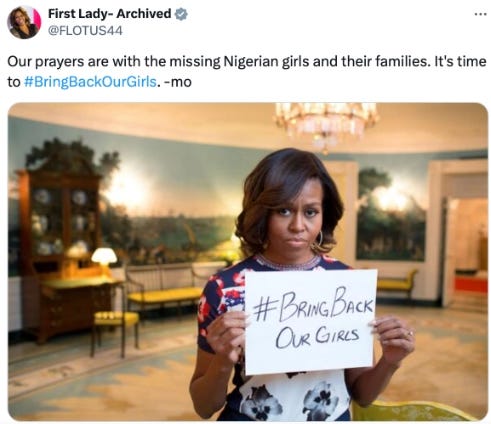
In April 2014, the abduction of more than 270 schoolgirls from the town of Chibok in northeastern Nigeria brought Boko Haram to unprecedented global attention. Images of empty classrooms and grieving families circulated worldwide, transforming what had largely been perceived as a regional insurgency into an international human rights crisis. The campaign to secure the girls’ release, most visibly captured by the slogan #BringBackOurGirls, was echoed by political leaders, activists, and public figures, including former U.S. First Lady Michelle Obama, whose public endorsement helped propel the case onto the global stage.
Although conflict disrupts entire societies, fragility and armed violence affect women and men differently, with women and children typically bearing the heaviest burden due to pre-existing social, economic, and political inequalities. In northeastern Nigeria, over a decade of conflict between Boko Haram and the state has displaced roughly 2.5 million people, of whom at least 79 per cent are women and girls. Displacement exacerbates poverty, food insecurity, and economic dependency, while simultaneously limiting access to education, healthcare, and reliable information. These conditions increase women’s and girls’ exposure to sexual and gender-based violence, early marriage, and exploitation, creating cycles of vulnerability that persist long after physical displacement occurs.
Ten years later, around 82 of the girls are still missing, illustrating how complicated and prolonged the aftermath of the abduction has been. Many of those who have returned have said they feel neglected by authorities and misled about the support and opportunities promised to them after their release. The 2018 kidnapping of schoolgirls in Dapchi highlights how such abductions are not isolated incidents, but part of a broader, evolving strategy of gendered violence. In 2016, Boko Haram fractured into two rival factions following ideological and strategic disagreements within the movement. Abubakar Shekau continued to lead the original Boko Haram faction, while the splinter group known as the Islamic State West Africa Province (ISWAP) aligned itself with the Islamic State. Although both groups emerged from the same insurgent roots, they developed distinct approaches to governance, civilian relations, and, crucially, the use of violence against women.
Under Shekau’s leadership, Boko Haram adopted an expansive and highly punitive definition of apostasy, which justified the mass abduction of women and girls. The 2014 kidnapping of more than 270 schoolgirls from Chibok exemplifies this strategy, in which girls were targeted not only as symbols of Western education but also as tools of terror, coercion, and propaganda. Many abducted women were subjected to forced marriage, sexual slavery, or coerced participation in violence, reflecting a deliberate use of women’s bodies to assert ideological dominance and punish perceived moral transgressions.
ISWAP, by contrast, has sought to distance itself rhetorically from Shekau’s brutality, attempting to project a more “disciplined” and less violent image toward Muslim civilians. This distinction was evident in the 2018 abduction of schoolgirls in Dapchi, where ISWAP released most of the girls within weeks, presenting the act as an exercise in religious mercy and moral restraint. Yet this apparent moderation should not be mistaken for a rejection of gendered violence. As Daily Trust reports, ISWAP has continued to instrumentalise women and girls through recruitment, logistical support roles, coercion, and, in some cases, direct participation in combat, often drawing on adolescents and women from conflict-affected communities (Daily Trust, 2021).
Despite their ideological differences, both Boko Haram and ISWAP rely on similar gendered logics that position women not as autonomous individuals but as symbols, resources, and instruments of war, whether as captives, wives, informants, or fighters. These practices are reinforced by broader gender norms that associate masculinity with aggression, control, and domination, normalising violence against women and children across conflict settings. As the Sahel and West Africa Club/OECD notes, such norms enable armed groups to legitimise sexual and gender-based violence as a tactic of war, embedding it within both ideological justification and everyday practice. This gendered violence is further intensified by the collapse of social protection systems. Prolonged insecurity and economic breakdown, as documented by New Lines Magazine, have forced families into desperate and often risky decisions in an attempt to protect their children, including sending them to distant relatives, informal caregivers, or religious schools. In the absence of effective oversight, these arrangements are frequently unsafe, exposing children to domestic servitude, forced labour, or trafficking, and often resulting in families losing contact altogether. Taken together, these dynamics reveal how gendered violence, displacement, and institutional failure intersect to produce long-term vulnerabilities that extend far beyond the immediate effects of conflict.
While women in northeastern Nigeria are disproportionately affected by conflict, framing them solely as victims obscures the ways they actively navigate, resist, and reshape violent environments. Scholars increasingly emphasise women’s agency rather than portraying them as passive recipients of harm. As Agbalajobi (2022) argues, displaced and conflict-affected women engage in peacebuilding, community mobilisation, and informal political participation, often filling governance and mediation gaps left by weakened state institutions. Through local reconciliation efforts, mutual aid networks, and advocacy within camps and host communities, women contribute to social cohesion and recovery. Crucially, evidence shows that peace processes that meaningfully include women are more durable and less likely to relapse into violence, underscoring women’s role not only as survivors of conflict but as central actors in its resolution.
This agency is particularly visible in women’s participation in the Civilian Joint Task Force (CJTF), a community-based security group formed in response to Boko Haram’s insurgency. Given that Boko Haram and ISWAP have frequently deployed women and girls as couriers, informants, and suicide bombers, women’s involvement in local security has become strategically essential. According to the New Yorker (2017) and Ogundiran (2020), women in the CJTF undertake critical roles including intelligence gathering, searching women at checkpoints, arresting suspects, and mediating disputes within their communities—tasks often inaccessible to male fighters due to gender norms. The experience of Fatima Muhammed, a CJTF member, illustrates both the significance and the risks of this involvement: motivated by the desire to protect her community, she operates at the intersection of care and coercion, facing threats from insurgents while navigating suspicion from state forces. Her story humanises women’s frontline participation and highlights how, even within militarised spaces, women assert agency, reshape security practices, and challenge reductive narratives that confine them to the margins of conflict.
The abduction of the Chibok schoolgirls marked a turning point in global awareness of Boko Haram’s insurgency, but the decade that followed reveals that attention alone has not translated into lasting protection or justice for women and girls. As this analysis has shown, gendered violence in northeastern Nigeria is not incidental to conflict but deeply embedded in its structures. Both Boko Haram and ISWAP, despite ideological and strategic differences, instrumentalise women’s bodies as tools of warfare, governance, and legitimacy, drawing on entrenched gender norms that normalise domination, control, and aggression. Displacement, poverty, and the collapse of social protection systems further intensify these vulnerabilities, producing long-term harms that persist well beyond moments of international visibility.
Yet focusing exclusively on women’s suffering risks reproducing the very marginalisation this violence depends upon. Women in conflict-affected communities are not only targets of violence but also critical agents of survival, resistance, and change. Through peacebuilding initiatives, informal political engagement, and frontline participation in community security structures such as the Civilian Joint Task Force, women actively reshape responses to insecurity, often at significant personal risk. Their involvement not only challenges dominant narratives of victimhood but also demonstrates that inclusive approaches to peace and security are more sustainable and effective. Recognising women as central actors rather than peripheral victims is therefore not only an ethical imperative, but a strategic necessity for addressing the root causes and long-term consequences of conflict in northeastern Nigeria.